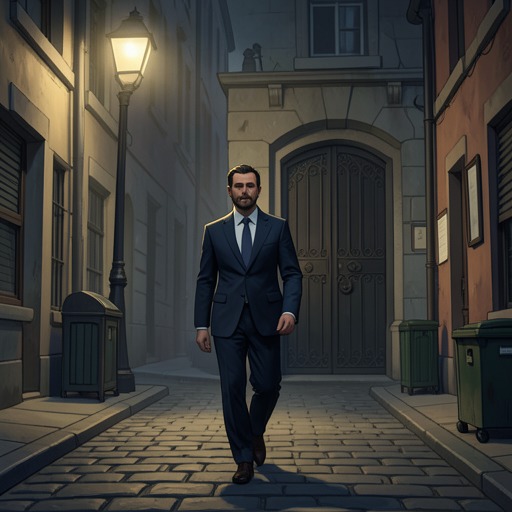
Harry Barry
A Killer’s MindHarry Barry is a reporter for the Chicago Daily Gazette whose coverage of the Strangling Undertaker cases changes direction when he recognizes that the most consequential story may be Zoe Bentley’s connection to the crimes. Capable, irreverent, and alert to the difference between a clickable headline and a narrative with lasting interest, he treats journalism less as a search for truth than as a search for a story people will remember. That distinction shapes both his work and his uneasy relationship with the investigation’s private stakes.
Identity and Work
Harry is a capable reporter, but his name has long felt like an obstacle to professional respectability. He signs his articles H. Barry, a form he believes sounds more conventional, yet he has never changed either of his names: he likes being Harry and belonging to the Barry family. His humor about this choice is characteristic. Rather than abandoning the names that invite jokes, he makes light of the absurdity and carries on.
His working habits are less polished than his byline. He smokes outside the Chicago Daily Gazette after the Chicago Clean Indoor Air Act complaints drove him and three other smokers from the office. The group settles in a small, dirty alley they call Lung Cancer Alley; since the move, Harry’s cigarette consumption has nearly doubled. In one scene, he finishes a cigarette, crushes the stub underfoot, and lights another while brooding over an article about the serial killer. The detail places his professional life amid ordinary irritations and self-mocking routines, rather than presenting him as a detached investigator.
The Case as a Story
Harry’s approach to the murders is established through his dissatisfaction with published coverage. In a bad mood, he sends his editor Daniel an email whose subject declares the article bad and whose only content is a link. When Daniel retaliates by assigning him an article about Justin Bieber, Harry looks for a way back to the subject he actually wants: the Strangling Undertaker. The exchange reveals a newsroom where assignments and editorial payback matter, but Harry’s choice also shows that the killings hold his attention as material for a better piece.
He needs an angle, and he knows that a headline can determine whether readers engage at all. At a flower vendor, he imagines framing the tragedy as a force that brings Chicagoans together. He plans to use tweets from prominent accounts and considers two competing forms of clickbait: a cliffhanger about a third victim or a list of ways Chicago is resisting the killer. The proposed article would turn shared grief into civic pride and online circulation. Harry can see both the emotional appeal and the commercial mechanics of that frame; neither, however, satisfies his instinct that a more substantial story is available.
That instinct is distinct from a commitment to factual truth. As he weighs whether to publish an article about mysterious envelopes left for a profiler, he recognizes that the subject could attract readers but would lack context, development, and an ending. He wants material that will make people talk, not merely click and forget. The novel makes his ambition vivid without equating it with investigative virtue: he is drawn to narrative force, and truth is not the principle he places first.
The Envelope and Zoe Bentley
At a memorial shrine, Harry approaches with a respectable bouquet and notices a plain brown envelope that the wind has knocked to the ground. He considers opening it before returning it to the mound of rocks, hesitating over whether journalistic curiosity crosses a line. The envelope is addressed to a woman, but not to Monique Silva; Harry recognizes the name. That recognition changes his estimate of the story. The object is not simply another detail at a crime scene: it suggests that the murders and someone’s personal history may be connected.
Harry’s interest then turns directly toward Zoe Bentley. When he meets her at the Behavioral Analysis Unit, he introduces himself as a fan who has read about her work on the Jovan Stokes case and earlier cases. His manner offends her, and she responds coldly. The encounter establishes an imbalance: Harry arrives already treating Zoe as a public figure whose history can be read and pursued, while she has not welcomed his attention.
By the time his article about the envelopes is ready, at half past five, Harry has given Zoe fair warning. He texts her; a minute later she calls to tell him he cannot publish the story. Her weary objection prompts a conversation rather than ending his inquiry. Harry’s notebook helps him concentrate, but it is mostly a prop: he is recording their exchange. The distinction matters to his method. He presents himself as listening and taking notes while preserving the conversation as usable material.
Maynard, Reporting, and the Case’s Afterlife
Zoe tells Harry that in 1997 a serial killer raped and killed three young women in Maynard, Massachusetts. A suspect was arrested and died by suicide while incarcerated. She then states her belief that the man who killed those women is the same serial killer now murdering in Chicago. Harry recognizes the significance of the connection, while Zoe rejects the media nickname The Strangling Undertaker: she says the killer is not an undertaker, but a killer controlled by fantasies and urges. Her account gives Harry what the envelope alone could not—an origin story joining the present investigation to the period when she was fourteen and growing up in Massachusetts.
Zoe tells him that the fuller story will come later and leaves money for their coffee, placing a twenty-dollar bill on the table after two cups. Harry replaces it with a crumpled ten-dollar bill. The small exchange ends their meeting on his terms of amused observation, but his conclusion is more consequential: he sees the real story not as either serial-killer case by itself, but as Dr. Zoe Bentley. His change of focus makes her biography the frame through which readers might understand the crimes, while also risking the reduction of her experience to journalistic material.
After the arrest, Harry’s reporting appears in a four-page article. Lieutenant Martinez, the Chicago police chief, and Christine Mancuso give him extensive interviews, and all three seek to minimize the FBI’s involvement. The article contains two pages about Zoe and identifies her correctly, but describes her only as a consultant and does not say whom she works for. It also contains a conspicuous error: Tatum Gray is rendered as Agent Dray. The account therefore preserves the authorities’ effort to limit the Bureau’s visibility even as it grants Zoe substantial space, and the typo punctures any impression of perfectly controlled coverage.
Harry’s interest in Zoe outlasts the arrest story. He later tells her that he has received a book deal to write about her and asks for more stories, adding that he has refrained from mentioning matters she may prefer to keep private. Zoe tells him to go to hell. His proposal extends the same tension that began with the envelope: Harry recognizes the narrative power of her history, but his appetite for further material meets her refusal to become an open subject. The novel leaves their relationship unresolved, with the reporting opportunity still attractive to him and the boundary unmistakable to her.